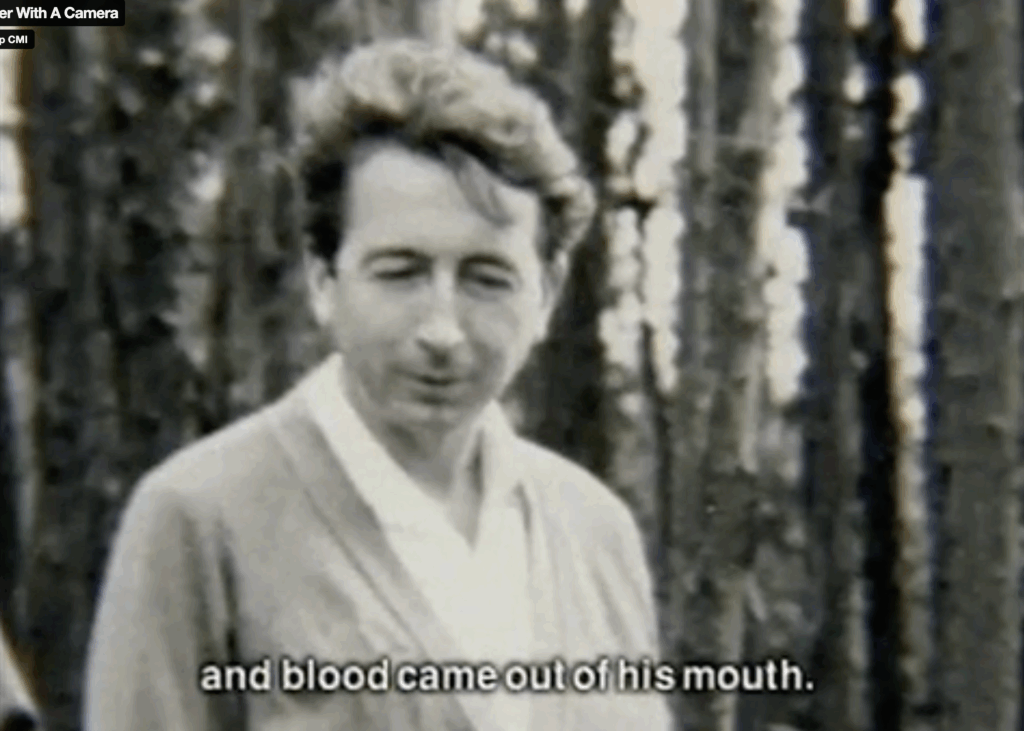
Throughout “Stranger with a Camera,” we see a lot of instances where outside documentarians and companies were going to Appalachia to document and shed light on the rampant poverty that existed. The premise of the documentary focuses on the murder of filmmaker Hugh O’Connor (shown below) at the hands of an Appalachian man named Hobart Ison. Ison killed O’Connor for being on his property and taking pictures of people in Appalachia. Many of the people who were interviewed in the documentary supported Ison because O’Connor was an outsider in the community.
The documentation of poverty in Appalachia can be connected to many moral/psychological/ethical tensions, but one that resonates deeply is the idea of embarrassment and the question of who is telling the story and why. The film represents this tension in a variety of ways. One way is by showing all the different companies that sent video and photography crews into Appalachia to show how the people lived. By showing these personal experiences, they were able to show an unknown and unseen struggle to people, but at the same time, they risked the dignity of the people they were showing. This also connects to one of the reasons Ison killed O’Connor: he didn’t want his community to be exploited and embarrassed. There was a part in the film where the documentarian says that how people understand and view their community affects how they want their community to be shown.
This is connected to Coles and a realization that Dr. Kenneth Clark brings forth. When talking about how Coles could get to know children who helped to desegregate New Orleans schools, Clark says, “‘If you were Negro and poor, you’d be hearing different words from those [Negro] children, writing up a different reserach project; and you sure wouldn’t even be thinking of (not in your wildest dreams!) doing interviews with white children and their parents–or with the schoolteachers’”(60). This comment leads Coles to be embarrassed and feel ashamed. Coles says, “He had stated the obvious, and though I was embarrassed by what he said and felt more than vaguely ashamed (for all of us in America, not just for myself), I didn’t (I couldn’t, I guess, and still can’t) realize the full import of his comment. There I was, in pursuit of some objective truth, so I thought, of a kind I could apprehend with those so-called “tools” of a particular “trade”…”(61).
By bringing out this sort of shame in Coles, Clark is highlighting the sort of “white savior” complex. This can be seen in a different way when thinking about Appalchia and the news coverage it received. By having these outsiders come in, they thought they were doing the right thing to expose the reality that many Americans faced, but in the end, they were just embarrassing and exploiting those people. Barret challenges this by being an insider to the community. Having grown up in rural Kentucky, she calls herself “a neighbor, wife, and mother with a camera” as opposed to a “stranger with a camera.” She also explicitly lays out what her goals for the documentary are. She reveals that she is from Appalachia, but she is from a weather family and area, therefore she is located differently than the poorer people. However, being from Appalachia, she can be an insider and show a less embarrassing and exploitative representation of the people.
Leave a Reply