One thing that will stay with me after this class is the importance of learning about other people and remembering that there is more to people’s stories than what we see on the surface. There were many different stories and experiences that we learned about in class, and I think this shows that everyone is unique. There were some similarities between stories, but ultimately, everyone views things differently based on their own experiences.
I also found that this was seen in everyone’s documentaries. Although we all had the same guidelines and assignment, everyone had different stories to tell, and everyone had different things that were important to them. It is so easy to judge a book by its cover, but that’s not always the best way to get to know people because you aren’t learning about their experiences. I also think that I am going to take away that documentary work is very challenging, but important. It can be really hard to make sure that you are telling someone’s story correctly, but ultimately, people’s stories need to be told.
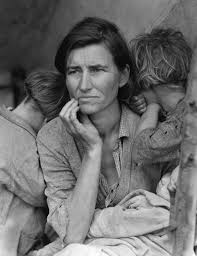
One image that really connects to these ideas is “Migrant Mother” by Dorothea Lange. We discussed this image a lot, and I think it is a great example of not judging a book by its cover. You may look at her and think one thing about her. But as we learned, she has a much deeper story of being Native American and a divorcee. All of these things would be unknown if you just looked at her picture, and didn’t learn about her story.
My documentary is very personal to me, as it reveals some of the ways that I was raised and how that has shaped me into who I am today. I am the youngest daughter, youngest granddaughter, and only girl in my family, which has caused the people in my life to spoil me ever since I was a small child. This is something that can happen because of the privilege that my family and I have, as we are an upper-middle-class family. Not all families have the same privileges for a whole variety of reasons. By revealing this about myself, I am engaging in a sort of self-scrutiny of how easily I am influenced to buy things because I have never had to worry about money. This is also amplified by consumer culture and how much social media can influence me and others around the world. We live in a world where online shopping provides endless opportunities to shop, and social media intensifies this by having influencers who promote items or styles. I know that I am a huge target of consumer culture, and this is something I talk about in my film. I use my voice in the film to provide context for who I am and how I am influenced by my upbringing to engage with social media and consumer culture, while also revealing the other ways that consumer culture can influence people and give them a sense of community and belonging.
I chose to have this theme for my documentary because I feel very connected and like I always have this person I love with me. The photos I used were supposed to show how caring and loving Noah is, and how safe I feel with him. When I met Noah, I did not expect him to become so important to me. But as I get to know him, I have learned that I can be unapologetically myself. I wanted to make this documentary in tribute to him and how he makes me feel.
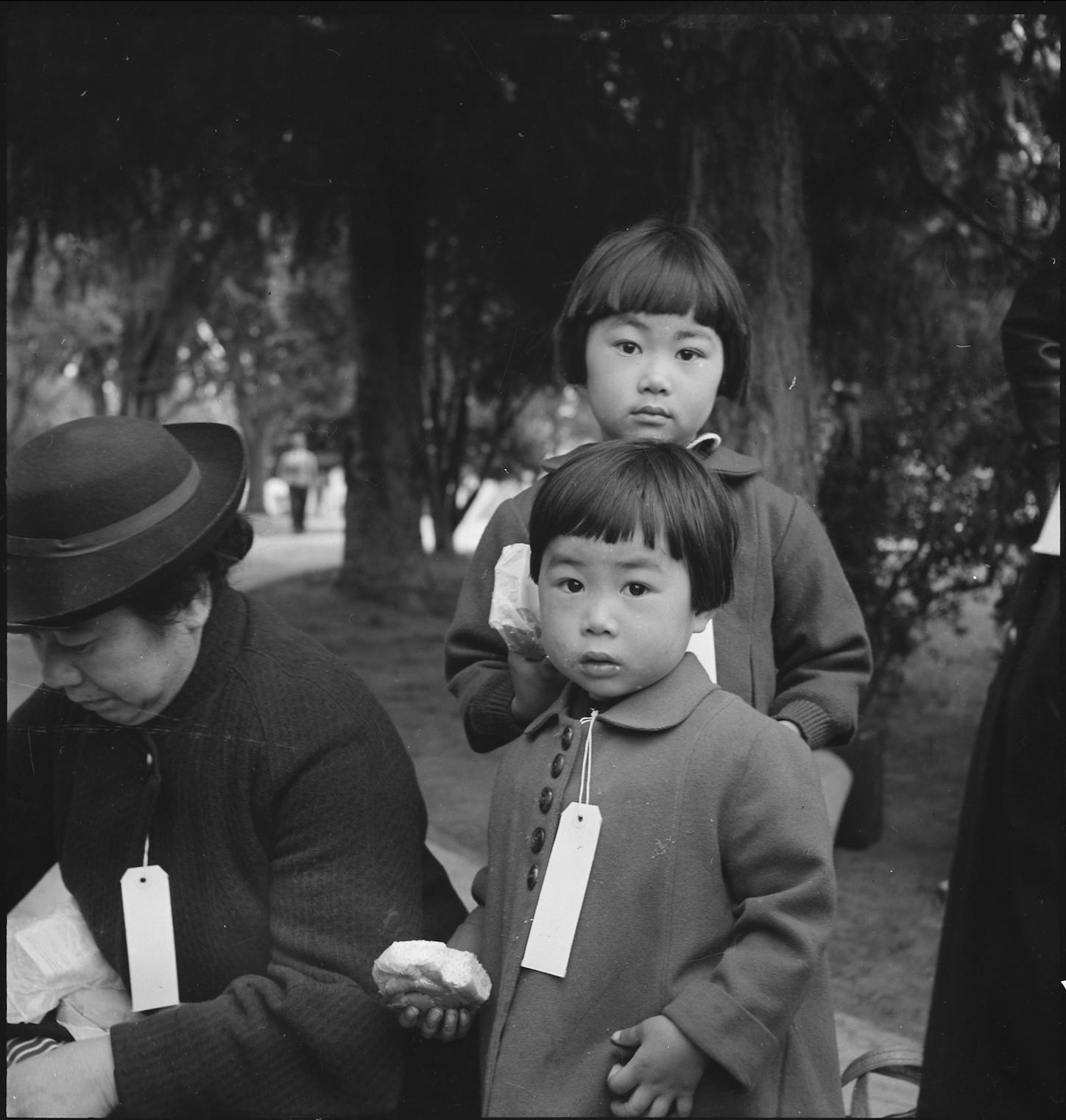
Dorothea Lange was known for her work throughout the Great Depression and afterwards. She was hired by the government to take photos of Japanese Americans who were put into internment camps to show that they were being treated “fairly,” as told by the American government. Like much of her work, this photo of children with tags around their necks, identifying them, has a large social impact. By capturing the seldom look of the children with their parents looking down, it draws the viewer into the grim photo, which illustrates the poor treatment they faced.
Lange believed that images could open the eyes of the viewer and prompt critical engagement. Linda Gordon’s “Dorothea Lange” introduction said: “ She believed that an imagery of democracy could contribute to building political democracy and that visual education could contribute to an active democratic citizenship. The responsibility she felt was not to provide solutions to problems, however, she told her students that documentary photographs should ask questions, not provide answers.” This quote can be connected to the image because the work she was doing with the American government was supposed to provide Americans with answers about what was happening to the Japanese Americans. However, this is not how Lange viewed her work and how she wanted to do her work. Therefore, she took photos like this one to cause the American people to question what their government was doing, by showing the true reality of what was happening, not what the government wanted them to see. Her work was also hoped to show the American people how to look at the images and examine what they are portraying to help make the country better. By changing the views of people and giving them hope for a utopian future by stopping the persecution of people, in this case, Japanese Americans.
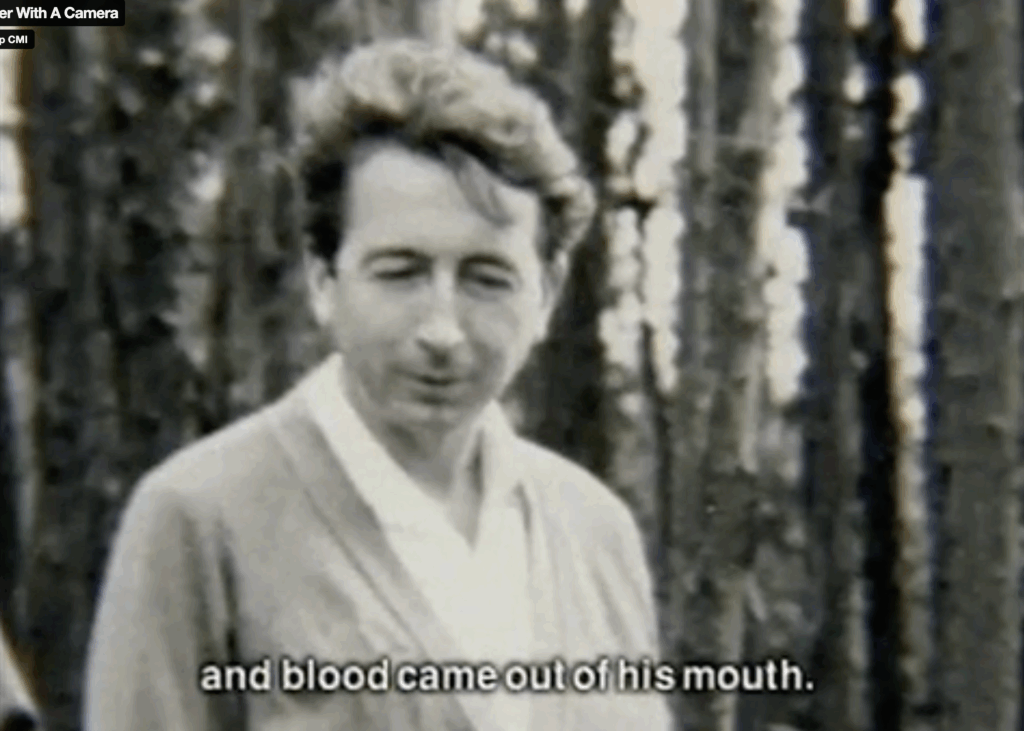
Throughout “Stranger with a Camera,” we see a lot of instances where outside documentarians and companies were going to Appalachia to document and shed light on the rampant poverty that existed. The premise of the documentary focuses on the murder of filmmaker Hugh O’Connor (shown below) at the hands of an Appalachian man named Hobart Ison. Ison killed O’Connor for being on his property and taking pictures of people in Appalachia. Many of the people who were interviewed in the documentary supported Ison because O’Connor was an outsider in the community.
The documentation of poverty in Appalachia can be connected to many moral/psychological/ethical tensions, but one that resonates deeply is the idea of embarrassment and the question of who is telling the story and why. The film represents this tension in a variety of ways. One way is by showing all the different companies that sent video and photography crews into Appalachia to show how the people lived. By showing these personal experiences, they were able to show an unknown and unseen struggle to people, but at the same time, they risked the dignity of the people they were showing. This also connects to one of the reasons Ison killed O’Connor: he didn’t want his community to be exploited and embarrassed. There was a part in the film where the documentarian says that how people understand and view their community affects how they want their community to be shown.
This is connected to Coles and a realization that Dr. Kenneth Clark brings forth. When talking about how Coles could get to know children who helped to desegregate New Orleans schools, Clark says, “‘If you were Negro and poor, you’d be hearing different words from those [Negro] children, writing up a different reserach project; and you sure wouldn’t even be thinking of (not in your wildest dreams!) doing interviews with white children and their parents–or with the schoolteachers’”(60). This comment leads Coles to be embarrassed and feel ashamed. Coles says, “He had stated the obvious, and though I was embarrassed by what he said and felt more than vaguely ashamed (for all of us in America, not just for myself), I didn’t (I couldn’t, I guess, and still can’t) realize the full import of his comment. There I was, in pursuit of some objective truth, so I thought, of a kind I could apprehend with those so-called “tools” of a particular “trade”…”(61).
By bringing out this sort of shame in Coles, Clark is highlighting the sort of “white savior” complex. This can be seen in a different way when thinking about Appalchia and the news coverage it received. By having these outsiders come in, they thought they were doing the right thing to expose the reality that many Americans faced, but in the end, they were just embarrassing and exploiting those people. Barret challenges this by being an insider to the community. Having grown up in rural Kentucky, she calls herself “a neighbor, wife, and mother with a camera” as opposed to a “stranger with a camera.” She also explicitly lays out what her goals for the documentary are. She reveals that she is from Appalachia, but she is from a weather family and area, therefore she is located differently than the poorer people. However, being from Appalachia, she can be an insider and show a less embarrassing and exploitative representation of the people.
Robert Cole brings up a number of issues and points in his introduction. He relates documentary work and the work of psychiatrists by bringing up the idea that people can not be impartial. He says that “we notice what we notice in accordance with who we are” (7). This can connect back to documentary work because it is impossible to be impartial out in the field, simply because of your identity.
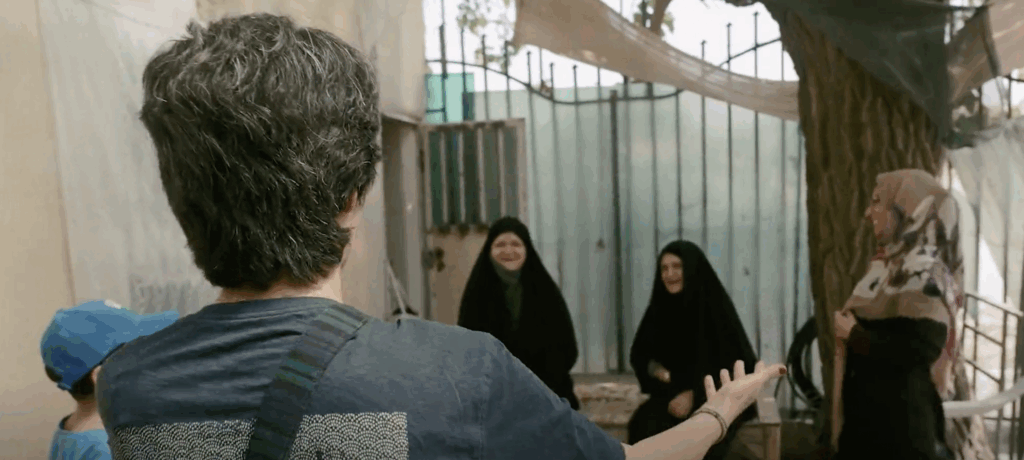
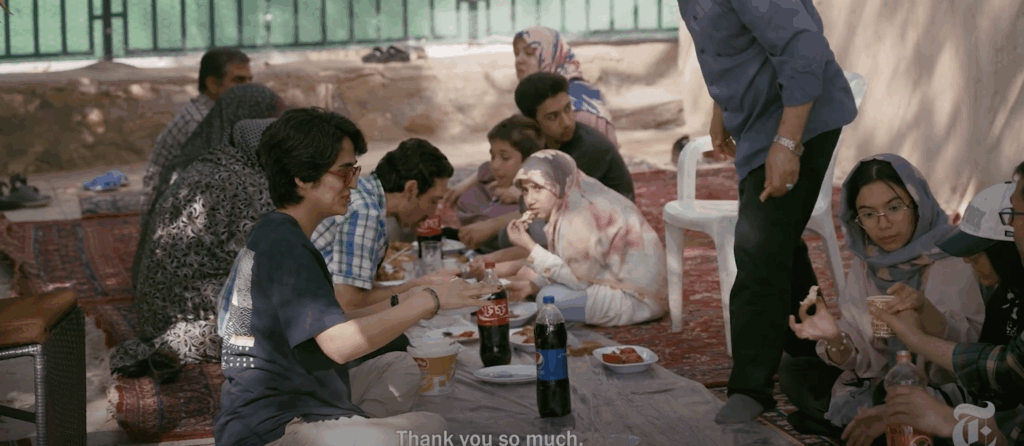
But how does Robert Cole define field? He says quite a few things about fields when it comes to documentary work. He also describes the field as “the critical matter being an attitude toward the life that surrounds one…”(14). In the case of “A Move,” the field is Elahe’s own family and friends. She is entering a place where she stands out from everyone else because of her beliefs and how she chooses to present herself. She depicts her home as one that is very traditional for Iran, and by entering the field, she is hoping to make a change and push the boundaries of what is socially acceptable for women. In many of the clips from the documentary, you can clearly see how Elahe stands out from those around her and is in stark contrast to the other women. This can further emphasize how Elahe is stepping into a place where she does not have the same attitude as those around her in order to help make a change.
Bob Moses is one person who stood out to me in chapter 1 of “Doing Documentary Work” by Robert Coles. “Once more, the issue is that of location–how a particular writer or researcher decides to commit himself or herself with respect to those others being studied, watched, heard, made the subject of a writing initiative” (32). In my opinion, his quote speaks to the main idea in this chapter. When doing documentary work, the creator has to make sure that they are taking good care of the subjects. This does not mean just consciously making an effort not to do harm. But understanding that they might be doing unintentional harm, and need to hold themselves accountable for that
Moses was the leader of a civil rights activist group called the “Student Nonviolent Coordinating Committee “ (SNCC). The part of the chapter that stood out to me is on page 38. Bob says: “Don’t you see, that’s been our story–the black story: everyone calls us something! …That’s where we are; that’s where we’re coming from; that’s our ‘place’ in all this! You folks–can be yourselves! You can wander all over the map. You can be here and you can be there. You can go set up your tent wherever you think it’ll do you good!… So, it’s location, man, location, for us: where we’re at, and where you’re at, and where we can go, and where you can go…” This quote stands out to me because it comes from a context of Coles going to the south during the civil rights movement in hopes of documenting what was going on with the movement. He met with the leader, expressing how different locations can be for black men and white men. It further connects to the idea of location, because Coles was able to go into the south and do his research because of his location as a white man. Because of this, he could be doing unintentional harm by trying to document what he is seeing. Moses says on 38: “In America, a guy like you makes a reputation when you’re here, studying us, if you come up with a bunch of psychological and sociological ideas about us…pretty soon it’s news and you write a book…they know about ‘types’ and ‘problems’ and ‘beliefs’– anything to bunch folks together in any way the one doing the ‘research’…can figure out, and the catchier the way its done, the bigger the payoff.”
These ideas that Coles and Moses are bringing up cause me to reflect on my experience visiting the house. On a civil rights tour of the South, I was taking pictures like this one to document my trip and everything that I had learned. As the trip went on, I realized that I was not doing the right thing by posting these things on social media. I was not aware of my location, and was not doing the work that should’ve been done on this trip. This further connects to Coles’ point about “the issue is that of location–how a particular writer or researcher decides to commit himself or herself with respect to those others being studied, watched, heard, made the subject of a writing initiative,” and this chapter and quotes really reminded me of that experience
“A Move” by Elahe Esmaili sheds light on a women’s movement in Iran, which focused on the wearing of hijabs. The documentary is a bit of commentary on this moment and the idea that women should wear hijabs, which appears to be a big belief of both men and older women in Iran. The documentary has a lot of different types of clips and scenes throughout. It highlights the difference between the daily life of men and women, as well as highlighting a lot of the social issues going on in Iran. The whole premise of the documentary is about a woman who refuses to wear a hijab; by doing this, she is actively taking a stand against her family and those around her.
Robert Cole brings up a number of issues and points in his introduction. He relates documentary work and the work of psychiatrists by bringing up the idea that people can not be impartial. He says that “we notice what we notice in accordance with who we are” (7). This can connect back to documentary work because it is impossible to be impartial out in the field, simply because of your identity.
But how does Robert Cole define field? He says quite a few things about fields when it comes to documentary work. He also describes the field as “the critical matter being an attitude toward the life that surrounds one…”(14). In the case of “A Move,” the field is Elahe’s own family and friends. She is entering a place where she stands out from everyone else because of her beliefs and how she chooses to present herself. She depicts her home as one that is very traditional for Iran, and by entering the field, she is hoping to make a change and push the boundaries of what is socially acceptable for women. In many of the clips from the documentary, you can clearly see how Elahe stands out from those around her and is in stark contrast to the other women. This can further emphasize how Elahe is stepping into a place where she does not have the same attitude as those around her in order to help make a change.